

Is Stability AI API free?
Hosted image, audio and 3D APIs with 25 starter credits for eligible new-account testing.
Current free offer summary
The getting-started guide grants 25 free credits to a new account created with Google sign-in; its key article uses broader new-account wording. Check the balance actually granted. This is a one-time starter allowance, not a daily or monthly refill. Core currently costs 3 credits per successful generation; other endpoints have different prices.
Stability AI API image examples
Artwork featured on Stability AI API's official site. Select an image to view it full size.

Judge composition at the size you need
The staircase draws attention through a densely textured scene. A similar illustration may work as artwork but compete with a small header’s text; compare readability after cropping and keep a simpler fallback for the app layout.

Readable example text is not a guarantee
This selected provider image includes a visible slogan. It does not guarantee exact lettering in your own request. Keep navigation, headings and instructions in ordinary editable text so spelling and accessibility remain under your control.

Inspect details and represent the image honestly
Check glasses, fingers and fabric edges at full size. A convincing generated portrait is not evidence that this person used your product; do not present it as a real customer testimonial or an unedited photograph.

SD 3.5 provider preview: portrait and lettering
The overhead view combines a portrait with visible lettering. Proofread generated words and examine hands and hair; this is a provider showcase rather than our Core endpoint test.
Provider artwork source · Source checked

SD 3.5 provider preview: portrait variations
The board compares skin, hair and lighting across different subjects. It remains one provider preview in this gallery, with no claim about prompts, seeds or account access.
Provider artwork source · Source checked
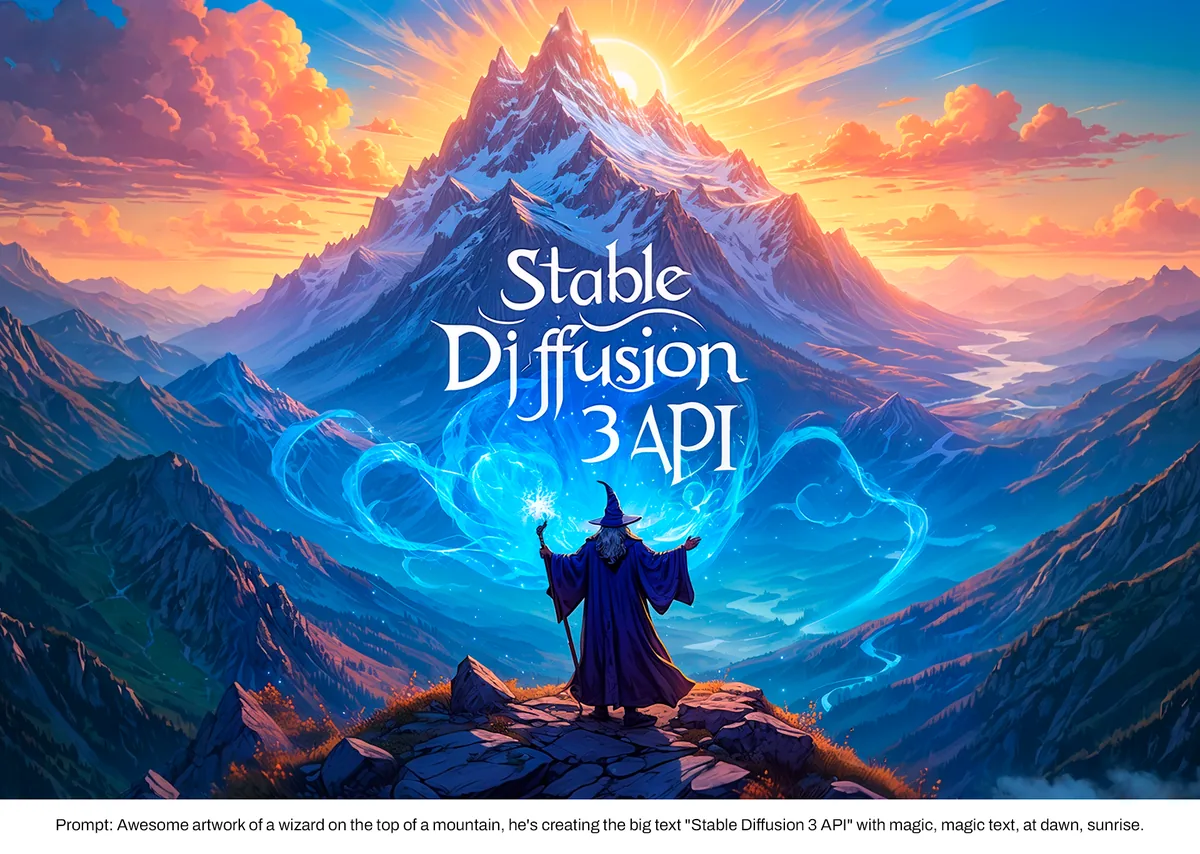
SD 3 provider preview: an illustrated adventure
The foreground figure gives the mountain scene scale. This historical Stable Diffusion 3 API announcement is distinct from the SD 3.5 previews and from our untested Core exercise.
Provider artwork source · Source checked
Source: Stability AI API's official artwork previews. These are Stability AI’s official Stable Diffusion 3.5 showcase previews, plus a clearly labeled historical Stable Diffusion 3 API preview, with the initial three checked October 3, 2026 and the additional sources checked October 8, 2026, not our own API results. They illustrate the provider’s model showcase rather than verified outputs from the Core endpoint used in this walkthrough. Exact prompts, settings, costs and export behavior are not established for these files.
Try the reading-app prototype promptWhat Stability AI API does
Stability AI exposes hosted generation and editing services through its developer API. The getting-started guide grants 25 free credits to new accounts created through Google sign-in. Prepare one authenticated image request, check the per-service price and inspect the returned file before integrating generation into an application.
- Image generation API
- Image editing API
- Image upscaling API
- Audio generation API
- 3D generation API
Best for
- ✓ Testing a single authenticated image request
- ✓ Prototyping image generation and editing in an application
- ✓ Comparing hosted endpoint costs
Important limits
- • Starter credits are one-time, not recurring free compute
- • Google-signup eligibility is explicit in the getting-started guide; verify the granted balance
- • Core costs 3 credits per success and high-cost upscalers can exceed the starter allowance
- • Credits issued from September 30, 2026 generally expire one year after issuance or purchase unless otherwise specified
- • API keys must stay out of browser code, public repositories and shared screenshots
- • Output rights depend on terms, acceptable use, model conditions and third-party rights
- • Applied watermarks and provenance markings must not be removed without permission
- • No universal card or visible-watermark rule was established
- • Self-hosted models and cloud-partner billing are separate from hosted API credits
FreeAIList verdict
A practical starting point for a developer who wants to learn one image endpoint before adding it to an application. At checked prices, a full untouched 25-credit balance fits eight successful Core generations with 1 credit left. Keep the key server-side, inspect responses and budget retries; choose a browser image tool if you only need a personal illustration.
Paid plans: One credit is priced at $0.01; additional credits are listed at $1 per 100 credits. Core costs 3 credits per successful generation, Ultra 8, Conservative Upscale 40 and Creative Upscale 60 at the checked rates. Prices can change; confirm the chosen endpoint before sending a request.
About this practical guide
Sources checked Oct 3, 2026
Based on Stability AI’s official getting-started guide, current pricing, Core API reference, key-management article and September 30, 2026 terms. We did not create an account, use an API key, send a generation request or test an output file. The prototype prompt is a starting point, not a demonstrated result.
Compare free image tools →How to prepare a first image API request
Use one request from a local API client or server before connecting generation to an application. This keeps the starter balance predictable and makes errors easier to diagnose.
Create the developer account
Open Stability’s developer platform. The getting-started guide explicitly links 25 free credits to creating an account through Google sign-in. Its key-management article uses broader new-account wording; check the balance actually granted instead of assuming every signup method receives the same offer.
Create and protect a key
Open your profile’s API Keys view and use the plus control to create a key. Store it in a server-side environment variable or secret manager. Never paste it into browser JavaScript, a public repository or a shared screenshot. Rotate and delete a key if exposed.
Choose Core and prepare the request
Use the official Stable Image Core request sample. It sends a POST with a Bearer authorization header and multipart form data. Choose Accept: image/* for binary output; let your HTTP client build the multipart Content-Type boundary rather than typing it manually.
Set a small, deliberate test
Put the exercise below in the prompt field. Set aspect_ratio to 16:9 and output_format to webp. Check Core’s current price and your balance before sending once. A style preset or fixed seed is optional; start without them so you know which input you changed.
Check the response before saving
On a successful image response, save the binary body as a WebP file and open it locally. On an error, inspect the status and error response instead of saving error text with an image extension. Record the endpoint, prompt and settings, then check the remaining balance.
Example: one header illustration for a reading app prototype
An imaginary reading app gives you a simple way to test composition without uploading a user’s photo or confidential design. Generate only the illustration; keep headings and buttons in your application’s ordinary interface. This prompt has not been run.
Example prompt to try
Wide flat illustration for a reading app prototype, one open book beside a small leafy plant on a simple desk, objects grouped on the right, generous plain cream space on the left, muted teal and warm orange accents, clean shapes, no people, no writing, no logos
- Does the downloaded file open as a real image? A 200 response and a saved filename are not substitutes for inspecting the file.
- Does the book remain recognizable in a narrow mobile header? Check cropping and small-object edges before generating another variation.
- Keep headings and buttons as accessible HTML or editable layout text. Generated lettering should not carry the app’s navigation or factual instructions.
- Save the prompt, aspect ratio and format alongside the result. Change one instruction for a retry so you can tell what improved the composition.
- Keep the API key out of the frontend. Before exposing generation to visitors, add server-side validation, authentication for private operations, rate limits and a spending cap appropriate to that application.
What can 25 starter credits cover?
At the checked rates, Core costs 3 credits per successful generation and Ultra costs 8. A full 25-credit balance could therefore fund eight successful Core results with 1 credit left, or three Ultra results with 1 left, if nothing else consumes the balance. These are budget calculations, not measured results or an offer of recurring free images.
One credit is priced at $0.01, and the getting-started guide lists $1 for 100 purchased credits. Other endpoints have different costs: the 40-credit Conservative Upscaler and 60-credit Creative Upscaler each exceed the entire starter balance. Do not assume every advertised service can be tried with 25 credits.
The Core reference says failed generations are not charged. That does not make blind retry loops a good idea: repeated successful requests consume credits, and a network timeout may leave you unsure whether the previous job completed. Check the response and account balance before retrying.
Starter credits do not refill daily. The current terms say unused service credits issued on or after September 30, 2026 expire one year after issuance or purchase unless otherwise specified. Check your own grant conditions and balance; no expiration date for an individual account is guessed here.
Stability’s current per-service credit prices ↗Fix the request before spending on another attempt
Core documents invalid-parameter errors, content-moderation rejection, rate limiting and server failures. Read the error response first. For a malformed request, check the required prompt, multipart encoding and allowed field values. For a moderation rejection, use a permitted brief rather than trying to bypass the controls.
If the key is rejected, verify its environment-variable setup and whether it is still active. Avoid printing the key or the full authorization header in logs. A lack of credits and a broken request are different problems; buying credits does not fix an invalid parameter.
For rate limits or temporary failures, use bounded retries with a delay and a way to stop. This page does not benchmark latency or promise that a retry will succeed. Keep a local placeholder illustration while the prototype’s API integration is being checked.
Stability API key creation and safe storage ↗Separate hosted API access from model licenses and output rights
Stability’s current service terms cover the API and assign its rights in compliant outputs to users to the extent permitted by law. You remain responsible for input permissions, third-party rights and acceptable use; ownership wording is not a promise of an exclusive or legally risk-free image. Applicable supplemental or model terms also need review.
The terms prohibit implying an AI output was human-generated and restrict removing applied watermarks or provenance markings without permission. A provider showcase or a clean-looking preview does not establish that every API output has no marks. Inspect the actual file and preserve applicable provenance.
Hosted starter credits and self-hosted model weights are different routes. The latter require your own hardware, setup and applicable model license; API credits are not free compute for running a downloaded model. The image API is also distinct from the provider’s audio apps and cloud-partner billing.
Stability’s service terms and credit-expiration rules ↗When to choose Dreamina instead
Consider Dreamina for a personal image experiment when you want to choose a model and edit a result in a browser rather than build an authenticated API request.
Dreamina has its own daily-credit eligibility, paid finishing options and uncertain commercial wording. Its browser balance does not transfer to Stability, and it does not establish a developer API quota. Choose the workflow you actually need before comparing credit numbers.
Official sources
These links support the important free-offer claims on this page.
- Stability account setup, Google starter credits and API authentication ↗
The getting-started guide explicitly grants 25 free credits for creating an account through Google sign-in, requires an API key in Authorization and lists purchased credits at $1 per 100. Starter access is not a recurring allowance.
- Stability per-service pricing and starter credit budget ↗
Pricing lists 25 starter credits, $0.01 per credit, Core at 3 credits, Ultra at 8, Conservative Upscale at 40 and Creative Upscale at 60. An untouched 25-credit balance fits eight Core successes with 1 credit left; not every advertised service fits the starter balance.
- Stable Image Core request, output and error reference ↗
Core takes authenticated POST multipart requests with prompt and optional aspect ratio, seed, style and format. Accept image/* returns binary output; the client sets the multipart boundary. Core costs 3 credits per success, failed generations are uncharged, and invalid input, moderation, rate limit and server errors require response handling.
- Stability API key creation and secret storage ↗
Profile opens API Keys; plus creates a key and X deletes one. Store keys in secret managers or environment variables, never client code or public repositories. The article describes 25 credits for new-account testing more broadly than the Google-specific getting-started guide.
- Stability service terms effective September 30, 2026 ↗
Terms cover the API, assign rights in compliant outputs where legally permitted, require third-party rights and acceptable-use compliance, restrict AI-output misrepresentation and unauthorized provenance removal. Unused credits issued from September 30, 2026 expire after one year unless otherwise specified; individual-account expiration is not guessed.
- Stability SD3.5 showcase and deployment routes ↗
Official SD3.5 showcase provides desert, retro monitor and portrait examples. Their exact prompts, settings and charges are not established; they are not verified outputs from the Core endpoint. Hosted API, self-hosted models and cloud partners are separate deployment routes.
- Dreamina browser image-workflow alternative ↗
Dreamina documents browser image generation, daily credits, model choices and editing with paid finishing options. Browser access is a different workflow from authenticated Stability API requests and does not transfer a developer credit entitlement.